HDR and 16-bit colour
04 About
oolonGoo's experimental HDR output and its 16-bit canvas: what they do, where they work today, and how to set them up.
Experimental
What HDR means here
MilkDrop and projectM output SDR only, and so does oolonGoo by default. With HDR on, it sends the display an HDR signal, scRGB 16-bit float or HDR10. At the default settings the lower half of the range looks as in SDR, and the brightest levels rise toward your display's peak, where bright saturated colours shift toward white. The menus stay at paper white. An optional P3 or Rec. 2020 gamut shows the same colours more saturated.
The 16-bit canvas
The 16-bit canvas draws presets with 65,536 levels in each colour channel instead of 256, so slow fades keep fading and gradients lose their 8-bit banding. It is a separate setting from HDR and works on any screen. On an SDR screen the picture still arrives in 8 bits, so the gain there is in fades and feedback; in HDR it also removes the banding that stretched 8-bit levels would show.
Backwards compatible with 8-bit presets
Presets made on an 8-bit canvas rely on its levels stopping at white between frames, and an earlier floating-point design let some of them run away. The 16-bit canvas stops at white exactly as the 8-bit one does, so they behave as they do there. It stays off by default: presets that depend on 8-bit rounding can look different, and chaotic feedback presets drift apart pixel by pixel while their overall levels stay close.
Where it works
Both features work with MilkDrop and projectM presets. HDR output is built in on Windows, macOS and Linux; so far it has been used on Windows.
- Windows. HDR output in scRGB or HDR10, once Windows HDR is on (Settings → Display → Use HDR, or Win+Alt+B).
- macOS. HDR output through the system's extended dynamic range (EDR), not yet tried.
- Linux. HDR output where the compositor offers an HDR colour space, not yet tried.
- The 16-bit canvas. Every platform, Raspberry Pi included, with or without an HDR display; checked on Windows so far.
What HDR output needs
An HDR display with HDR turned on in the system, and a GPU and Vulkan driver that offer an HDR colour space, scRGB or HDR10. Without them, oolonGoo stays in SDR and the HDR row says why.
Turn it on and calibrate
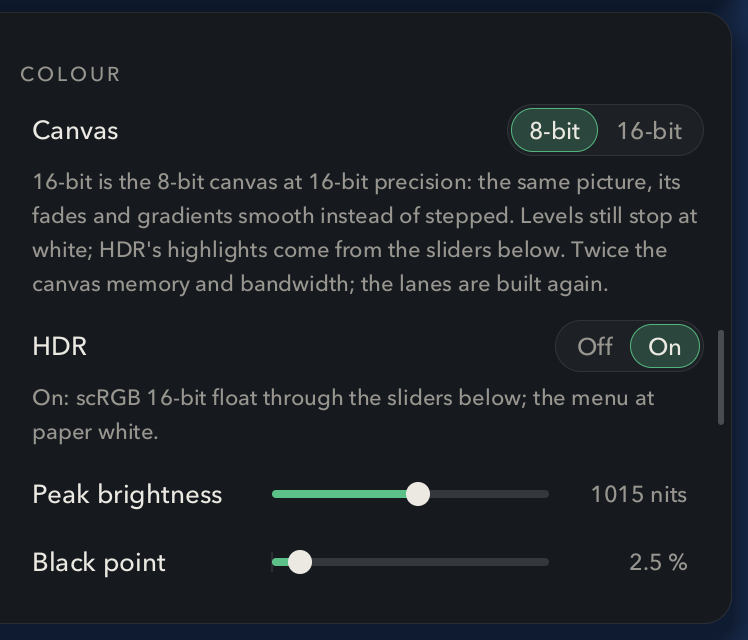
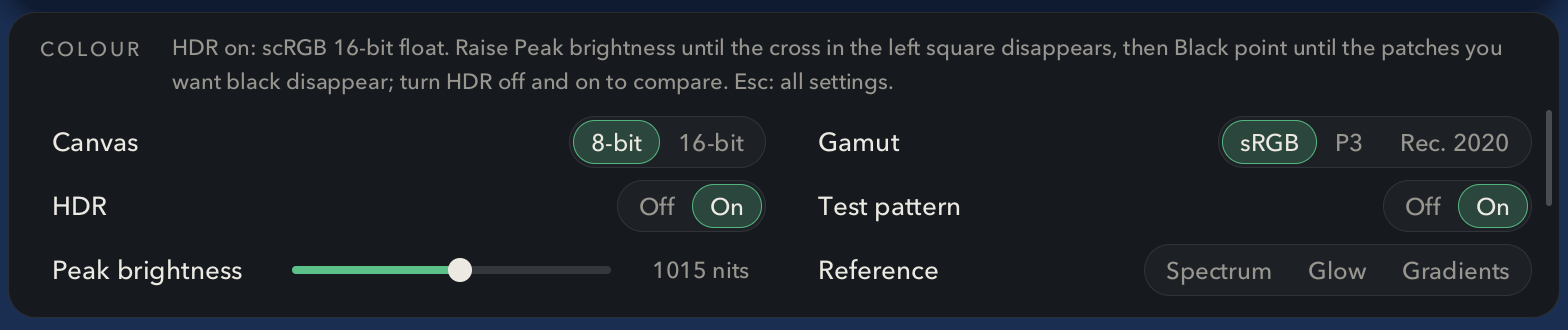
Open Settings and find COLOUR. Canvas switches between 8-bit and 16-bit; HDR turns HDR output on, and the sliders below it work while it is on. Turn on Test pattern and Settings becomes a calibration band: raise Peak brightness until the cross in the left square disappears, then Black point until the patches you want black disappear. Reference loads one of three presets of oolonGoo's own, Spectrum, Glow or Gradients, to compare the settings.
Screenshots and recordings of oolonGoo capture the SDR picture, never the HDR output.
What it costs
The 16-bit canvas takes twice the canvas memory and bandwidth. Bandwidth-heavy presets take up to about twice the GPU time; shader-heavy presets cost about the same. On a GPU without the 16-bit format, oolonGoo keeps the 8-bit canvas and says why.
Why it matters
Presets still draw levels up to white, in sRGB colour, and today HDR stretches that picture onto the display's larger range rather than adding to it. The room is there now, though. In the long term, a 16-bit canvas and an HDR signal open up possibilities that 8-bit SDR never had, such as larger, more organic colour ranges.